1. Context is important:
Issues in the Mid-East are at once simpler and more complex than they seem from Canada. Take the Golan Heights. From Toronto, it seems like a little chunk of land, a few kilometres across. Give it back, call it a done deal, no problem, right? Except that when you get there, you realize it is one of the most lush spots in Israel, controls the source of much of the country's water, and is strategically essential in preventing the totalitarian nuts in Damascus from rolling into northern Israel.
But maybe it is simple, in the end. Put in an international observer force, with teeth, set up compensation tribunals, etc. Similarly with the Palestinian refugees and the 'right of return'. It's never going to happen that Israel will allow 4-6m people into the country - they would immediately outnumber Jews. But I think money is more useful than people give it credit. Properly negotiated, I would be surprised if the issue persisted. What form will these future solutions take? What is adequate compensation?
2. Civil society and institutions
Many of the Israeli speakers we listened to mentioned the lack of a negotiating partner on the Palestinian side as a major hurdle. They felt there wasn't any nuance to the debate in Palestine - any viewpoints that suggested tolerating Israel were literally eliminated. One of the problems as I see it is the lack of rudimentary civil institutions in Palestine. These include things like a power authority, incorruptible police and security forces, a free press, and so on. Without these things, there can be no challenge to the predominant view of Hamas that Israel should be eliminated.
That is a really harmful position, principally for Palestinians. Pragmatically, I can't see Israel being defeated and ceasing to exist. They have powerful allies, are a strong democratic country that largely conforms to humanistic principles, and won't be bothered by a few Qassam rockets.
How can the international community help build 'capacity' or institutions in Palestinian territories (and in other countries)? How do you start a free and independent media in a place where people are afraid to go outside their houses?
3. Separation of Jewishness and Israeli-ness
What makes a Canadian? Back in the WW2 era it might have been something like a Protestant background, British colonial mentality, penchant for order and 'good government'. Now, though, I think a Canadian is more a set of shared experiences -- living next to the world's superpower, tolerance for other cultures (not acceptance), bilingualism, etc.
In Israel it seems to me this notion of identity is still quite bound up in Judaism -- that is, a set of religious beliefs. And this isn't a good thing. It means that an Israeli is still seen as Jewish, when the reality of the state they live in is that 1/3rd of the people aren't Jewish. Nor, in a modern nation, should religious affiliation matter. Naomi Chazan mentioned this concern when she talked with us at dinner on May 15. According to her, Orthodox religious leaders still control marriage, Sabbath activities, and other things. How does this fit in with the ideals of a modern, humanist society? This isn't to cast Orthodox Judaism as antithetical to human rights; still, my belief is that religious leaders have for a long time shown themselves incapable of respecting universal human rights. A modern Israel would embrace a constitutional separation of religion and secular state affairs. But how can Israel transition to such a state?
Wednesday, May 23, 2007

Arrival
(written late at night in the Tiberias Sheraton)
Departure went without a hitch on the typically efficient TTC connection to the airport. I was nervous about the flight being too long, and my fears seemed realized when hour 6 rolled by and we were still somewhere over the Atlantic. At the rear of the plane a number of young Jews were traveling to Israel as part of the Birthright program. They were very excited and rowdy which made sleep nearly impossible. Movies were Eragon (awesomely bad), Bridget Jones (silly and bad), and Dreamgirls (not watched). No personal TV, sadly.
Somehow the flight eventually ended after a very quick and twisty approach. Later, watching the planes fly slowly over the beaches of Tel Aviv, I could see why they might want to get the approach over with. Customs was slow, perhaps because it was only 11am. Nonetheless, a Canadian with Pakistani-Saudi roots in our party was detained (in the end) for 6 hours. We left ahead of him -- little we could do -- and, after a quick stop at the hotel, headed for old Jerusalem with our guide, Tsvi Sperber.
Tzvi is a British-born Orthodox Jew who speaks English with a broad (midlands?) accent. He also speaks quick Hebrew. He came to Israel in his 20s and now works as a guide and historian, after spending a few years doing archaeology. Throughout the trip he was knowledgeable and efficient.
Due to the late arrival from the airport, our tour of Jerusalem was very fast, and we rushed through a variety of sites/sights. At one point we stopped at the supposed Tomb of David (King of the Jews), and conjointly room of the Last Supper. Tsvi pointed out these designations were highly improbable and that it was more likely the Crusaders, looking for tourist money, who named the sites.
We also saw the Western Wall, Armenian quarter, Temple Mount, and the Church of the Holy Sepulchre. Fortunately Tzvi is very approachable and essentially a walking Wikipedia on Israel and religion, so I still learned a lot. My biggest impression was the intense, almost rapturous behaviour of Jews and Christians at their holy sites. We also rendez-voued with our lost sheep, who had successfully convinced the guards he was harmless.
Our hotel was the Mount Zion, which overlooks the Jericho Gate and the old city opposite. Before the 1967 war, the road beside the hotel was No Man's Land between the Jordanian and Israeli positions (after the 1948 war). The grounds of the hotel are splendid with blossoms.
After a quick freshening up we headed off to meet the hosts of the trip, Larry and Judy Tanenbaum. Dinner was at a replica Bedouin encampment overlooking the Judean desert and the Jordan valley. Larry Tanenbaum is a of average height with loose facial features but piercing and perceptive blue eyes. He is the part owner of Maple Leaf Sports, and until a few days before the trip was watching his team, the Raptors, in the playoffs. His wife, Judy, the principle organizer, is slightly shorter, dressed crisply and expensively, looking tastefully young. They were both genuinely happy to meet the recipients of their fellowship. Also at the dinner was Haim Divon, former Israeli ambassador to Canada, and his daughter Michelle.
The dinner was a fabulous introduction to Israel, and the Middle East in general. We sat on mattresses and dined on a variety of shared dishes like pickled vegetables, homous, breads, and kebabs and meatballs. To finish we joined a drumming circle.
We were asked, at the end of the night, to share our perspective on Israel to date. For me it was geographic -- the landscape is so much more mountainous than I expected. I also mentioned the deep faith and meaning the various locations have for people.
After our return to the hotel, four of us joined a friend of Jared's, Ran Goel, for drinks in the Ben Yehuda district. The atmosphere, despite security worries, was fantastic, young people enjoying themselves as they do the world over. I found I had adjusted readily to the security realities - armed guards are at every post, and an armed security guard escorted us everywhere.
By 2am, after a few GoldStars and hookah, we realized we hadn't slept in over 30 hours, and took a cab back to the hotel.
Departure went without a hitch on the typically efficient TTC connection to the airport. I was nervous about the flight being too long, and my fears seemed realized when hour 6 rolled by and we were still somewhere over the Atlantic. At the rear of the plane a number of young Jews were traveling to Israel as part of the Birthright program. They were very excited and rowdy which made sleep nearly impossible. Movies were Eragon (awesomely bad), Bridget Jones (silly and bad), and Dreamgirls (not watched). No personal TV, sadly.
Somehow the flight eventually ended after a very quick and twisty approach. Later, watching the planes fly slowly over the beaches of Tel Aviv, I could see why they might want to get the approach over with. Customs was slow, perhaps because it was only 11am. Nonetheless, a Canadian with Pakistani-Saudi roots in our party was detained (in the end) for 6 hours. We left ahead of him -- little we could do -- and, after a quick stop at the hotel, headed for old Jerusalem with our guide, Tsvi Sperber.
Tzvi is a British-born Orthodox Jew who speaks English with a broad (midlands?) accent. He also speaks quick Hebrew. He came to Israel in his 20s and now works as a guide and historian, after spending a few years doing archaeology. Throughout the trip he was knowledgeable and efficient.
Due to the late arrival from the airport, our tour of Jerusalem was very fast, and we rushed through a variety of sites/sights. At one point we stopped at the supposed Tomb of David (King of the Jews), and conjointly room of the Last Supper. Tsvi pointed out these designations were highly improbable and that it was more likely the Crusaders, looking for tourist money, who named the sites.
We also saw the Western Wall, Armenian quarter, Temple Mount, and the Church of the Holy Sepulchre. Fortunately Tzvi is very approachable and essentially a walking Wikipedia on Israel and religion, so I still learned a lot. My biggest impression was the intense, almost rapturous behaviour of Jews and Christians at their holy sites. We also rendez-voued with our lost sheep, who had successfully convinced the guards he was harmless.
Our hotel was the Mount Zion, which overlooks the Jericho Gate and the old city opposite. Before the 1967 war, the road beside the hotel was No Man's Land between the Jordanian and Israeli positions (after the 1948 war). The grounds of the hotel are splendid with blossoms.
After a quick freshening up we headed off to meet the hosts of the trip, Larry and Judy Tanenbaum. Dinner was at a replica Bedouin encampment overlooking the Judean desert and the Jordan valley. Larry Tanenbaum is a of average height with loose facial features but piercing and perceptive blue eyes. He is the part owner of Maple Leaf Sports, and until a few days before the trip was watching his team, the Raptors, in the playoffs. His wife, Judy, the principle organizer, is slightly shorter, dressed crisply and expensively, looking tastefully young. They were both genuinely happy to meet the recipients of their fellowship. Also at the dinner was Haim Divon, former Israeli ambassador to Canada, and his daughter Michelle.
The dinner was a fabulous introduction to Israel, and the Middle East in general. We sat on mattresses and dined on a variety of shared dishes like pickled vegetables, homous, breads, and kebabs and meatballs. To finish we joined a drumming circle.
We were asked, at the end of the night, to share our perspective on Israel to date. For me it was geographic -- the landscape is so much more mountainous than I expected. I also mentioned the deep faith and meaning the various locations have for people.
After our return to the hotel, four of us joined a friend of Jared's, Ran Goel, for drinks in the Ben Yehuda district. The atmosphere, despite security worries, was fantastic, young people enjoying themselves as they do the world over. I found I had adjusted readily to the security realities - armed guards are at every post, and an armed security guard escorted us everywhere.
By 2am, after a few GoldStars and hookah, we realized we hadn't slept in over 30 hours, and took a cab back to the hotel.
Back in Canada
Apologies for the complete lack of updates. The itinerary, which I'm posting below in abbreviated form, was tight, and the tubes of the Interweb hard to access. So... over the next few days I'm going to post a few comments on what we did, focusing on reflections from the many things that were seen.
Our itinerary:
Our itinerary:
11:25 Arrival at Ben Gurion International Airport on flight AC 084
15:15 18:30 Tour the Old City of Jerusalem
19:00 19:30 Cocktails with your hosts Judy and Larry Tanenbaum and introduction to the land of Israel with Tzvi Sperber
19:30 Hafla dinner at Eretz Bereshit in the Judean desert
Overnight: Mount Zion Hotel, Jerusalem
TUESDAY, MAY 15
07:45 09:00 Breakfast briefing at the hotel on the current state of Israeli politics with Dr. Reuven Hazan, Professor of Political Science, Hebrew University of Jerusalem
09:45 10:45 Meeting with Likud MK Yuli Edelstein at the Knesset
11:30 12:30 Briefing at the Israel MFA – “Israel’s Strategic Outlook” with Igal Palmor, Director of the Magreb-Syria-Lebanon department at MFA and Ronen Gil-Or, Deputy Director, First North America Department - TBC
12:40 13:20 Packed lunch at the Rose Garden
13:30 14:30 Visit the Supreme Court with Marcha Friedman to talk about the Israeli Law system and Professor Allen Zysblat Adjunct Professor at the Faculty of Law of the Hebrew University of Jerusalem to talk about the influence of Canadian law on Israeli legislation and case law, and generally about the potential for Canada-Israel legal cooperation
15:00 16:30 Meetings at the American Colony Hotel with Palestinian representative (Hanna Siniora)
and Ulric Shannon, Senior Political officer at the Canadian representative office to the Palestinians - TBC
16:45 18:30 Jerusalem Security barrier tour with Avi Melamed, former Senior Advisor, Arab Affairs to the Mayor of Jerusalem
18:15 19:45 Return to hotel and time to freshen up
20:00 Dinner at Anna Ticho House with former Knesset Member, Professor Naomi Chazan on social policy issues and the status of woman in Israel
Overnight: Mount Zion Hotel, Jerusalem
WEDNESDAY, MAY 16
08:00 09:00 Breakfast briefing - Overview of the Middle East Peace Process and talk on NGO's with Dr. Gerald Steinberg, Editor, NGO Monitor and Director, Program on Conflict Management and Negotiation, Bar Ilan University
09:00 Mifgash starts
09:15 Check out and depart hotel
10:00 11:00 Visit Maale Adumim, the largest Israeli town in the West Bank and meet with Herb Keinon, diplomatic correspondent for the Jerusalem Post – Location TBC
11:00 12:30 Drive north on route 90 along the Israel - Jordanian border
12:30 13:30 Lunch at the Beit Shean Mall
15:00 15:45 Visit Mount BenTal on the Golan Heights and talk on security related issues with an IDF spokesperson - TBC
16:15 18:00 Tour/Hike in the Golan Heights
18:00 19:00 Drive to Hotel
19:00 20:15 Check-in at the Sheraton Hotel and time to freshen up
20:30 Dinner at Deck's on the shore of the Kineret river
Overnight: Sheraton Hotel, Tiberia
THURSDAY, MAY 17
07:15 07:45 Breakfast and check out
08:00 09:30 Visit to the Christian sites around the Sea of Galilee
09:30 11:00 Drive to Haifa
11:00 12:00 Visit the Bahá’í Gardens and meet with a representative for an introduction on the Bahá’í faith (Dress code: modest)
12:30 14:00 Lunch and visit to the Golda Meir Mount Carmel International Training Center to learn about Israel’s development work abroad with its Director Mazal Renford
14:00 15:30 Depart Haifa and drive to Holon
15:30 17:00 Visit to the "Save a Childs Heart Project" in Holon
17:00 17:45 Depart to Tel Aviv
17:45 19:45 Check into the Sheraton Moriah Hotel and time to freshen up
20:00 Dinner at La Relais Jaffa restaurant with Aluf Benn, Diplomatic Editor of Haaretz
Mifgash ends
Overnight: Sheraton Moriah Hotel, Tel-Aviv
FRIDAY, MAY 18
08:30 09:00 Breakfast
09:30 10:30 Meet with Canadian Ambassador Jon Allen at the Embassy
11:00 12:30 Visit the neighborhoods of Jaffo and Neve Tzedek
12:30 14:30 Lunch on own and Shopping on Nahalat Binyamin, arts & crafts outdoor Market
14:30 17:30 Free time
17:30 19:00 Return to hotel to freshen up
19:15 21:00 Dinner at Bellini Restaurant
21:30 Mayumana show, dance and percussion
Show starts at 22:00
Drinks at the Old Port in Tel Aviv - Optional
Overnight: Sheraton Moriah Hotel, Tel-Aviv
SATURDAY, MAY 19
08:00 08:30 Breakfast
08:30 Check out
08:30 10:30 Depart for the Dead Sea Region and meet up with Tour Guide Itai Lavee
10:45 12:00 Cable car up Masada (ancient Roman/Jewish fortress) and tour site
12:30 15:30 Rest, Swim and Lunch at the Crown Plaza Hotel, Dead Sea
16:00 17:00 Hike the natural reserves of Ein Gedi
17:00 18:00 Drive to Jerusalem
18:00 20:00 Check in and time to freshen up
20:30 21:30 Dinner at Grill Bar on the downtown Ben-Yehuda pedestrian mall
Walk and free time on the downtown pedestrian mall, Ben-Yehuda Street
Overnight: Mount Zion Hotel, Jerusalem
SUNDAY, MAY 20
07:30 08:30 Breakfast briefing with Khaled Abu Toameh - Palestinian Affairs correspondent for the Jerusalem Post – “An inside view of Palestinian Politics”
9:00 11:30 Visit Israel's National Holocaust Museum, Yad Vashem
11:30 12:30 Drive to Rehovot
12:30 13:15 Lunch
13:30 15:00 Visit to the Weizmann Institute of Science in Rehovot, (one of Israel's leading center’s of scientific research)
16:00 17:30 Archeological dig
18:00 19:00 Visit the Nachson Winery
19:00 19:15 Return to Jerusalem
19:15 20:15 Return to hotel and time to freshen up
20:30 Dinner at Canella restaurant in downtown trendy neighborhood
Overnight: Mount Zion Hotel, Jerusalem
MONDAY, MAY 21
08:00 08:30 Breakfast
09:00 10:30 Visit the Gilo Center for Citizenship, Democracy and Civic Education at the Hebrew University of Jerusalem
11:00 13:00 Visit to the Israel Museum – Explore exhibit on settlement in Israel from the ancient period onward
13:15 15:00 Lunch at Tzachko in the Iraqi Market and brief tour of the Mahane Yehuda outdoor market
15:30 17:30 Visit the City of David, revealing some of the most exciting archeological finds of the ancient world
17:45 18:45 Last minute shopping on Ben Yehuda Street
18:45 19:15 Personal summary with camera crew
19:15 20:15 Freshen-up at hotel
20:30 Group Summary at Darna over dinner
Overnight: Mount Zion Hotel, Jerusalem
TUESDAY, MAY 22
08:30 09:00 Breakfast
09:15 Check out
09:30 10:30 Transfer to airport
12:55 Flight to Toronto on AC 085
Saturday, May 12, 2007
T-1
Right, just packing things for departure tomorrow. In general I think on most trips one can get by with a very minimal amount of clothing - outerwear anyway, the underwear always seems problematic. My dad is great at this - I think he just brings one pair of pants, one long-sleeved shirt, and a jacket. I haven't had the courage to ask about underwear :)
Took a look at the weather today in Tel Aviv. It's a balmy 28-30 degrees, should hold for a few more days too. The list we get from the trip organizer suggests three pairs of pants, but I dunno... certainly don't want jeans. The challenge is to bring clothes for touring around, but a few occasions we'll get to go to 'nicer' places, where a slightly more polished look is called for. I'm squeezing everything into my soccer bag, wheels on the back for airport lugging.
The trip will be nine days, and is sponsored by Larry and Judy Tanenbaum. Working with National Jewish Campus Life, they want to expose young people to a view of Israel that news reports don't always convey. Certainly the many, often conflicting viewpoints of the situation in the Middle East have crossed my mind more than a few times. I look forward to expanding my opinions of the region with a little first-hand knowledge -- a damn rare thing these days, it seems.
One thing I find hard to grasp, partly due to my largely secular upbringing, is the way some communities define themselves with faith. I read an essay by Bernard Lewis in which he highlighted how Islam is more than just religion, but a way of life. The same is true for many Jews I think. Is a Jew someone who practices Jewish religious traditions? I suspect there are people who observe religious ceremonies about as much as I do (not much), yet would still identify as Jewish. The history of the Jewish people is almost as important to the story as the religious beliefs are. I think this deeply intertwining of both faith and culture is a big part of the story.
Regarding tomorrow, I'm nervous, not about flying, but about the experiences to come. It seems so intimidating to think of the new stories, friends and photos that come from the next 9 days... but onward to the Holy Land.
Took a look at the weather today in Tel Aviv. It's a balmy 28-30 degrees, should hold for a few more days too. The list we get from the trip organizer suggests three pairs of pants, but I dunno... certainly don't want jeans. The challenge is to bring clothes for touring around, but a few occasions we'll get to go to 'nicer' places, where a slightly more polished look is called for. I'm squeezing everything into my soccer bag, wheels on the back for airport lugging.
The trip will be nine days, and is sponsored by Larry and Judy Tanenbaum. Working with National Jewish Campus Life, they want to expose young people to a view of Israel that news reports don't always convey. Certainly the many, often conflicting viewpoints of the situation in the Middle East have crossed my mind more than a few times. I look forward to expanding my opinions of the region with a little first-hand knowledge -- a damn rare thing these days, it seems.
One thing I find hard to grasp, partly due to my largely secular upbringing, is the way some communities define themselves with faith. I read an essay by Bernard Lewis in which he highlighted how Islam is more than just religion, but a way of life. The same is true for many Jews I think. Is a Jew someone who practices Jewish religious traditions? I suspect there are people who observe religious ceremonies about as much as I do (not much), yet would still identify as Jewish. The history of the Jewish people is almost as important to the story as the religious beliefs are. I think this deeply intertwining of both faith and culture is a big part of the story.
Regarding tomorrow, I'm nervous, not about flying, but about the experiences to come. It seems so intimidating to think of the new stories, friends and photos that come from the next 9 days... but onward to the Holy Land.
Sunday, May 6, 2007
Israel awaits...
In a week's time I'll be heading off on an 11-hour flight to Tel Aviv for just over a week in Israel. This is a trip organized by Massey College. In preparation for the trip, I've tried to 'bone up' on the region.
As you might imagine, there have been plenty of books written on the area. The two I looked into were the Mark Twain travelogue, "The Innocents Abroad"; and Bernard Lewis, "Islam and the West". The latter is more of a collection of essays, but it's pretty interesting reading. I really was looking for some fictional stories that used Jerusalem/Tel Aviv etc. as the landscape/setting, but I haven't tracked anything down (maybe an Agatha Christie book?). I did read the latest Jack Whyte book on the Knights Templar. It is set in First Crusade-era Jerusalem, which was neat, but he doesn't do a great job recreating the landscape; his focus is more on the (frankly boring) history of the Christian religion.
My brother recommended the movie "Route 181", but I haven't had any luck finding it anywhere.
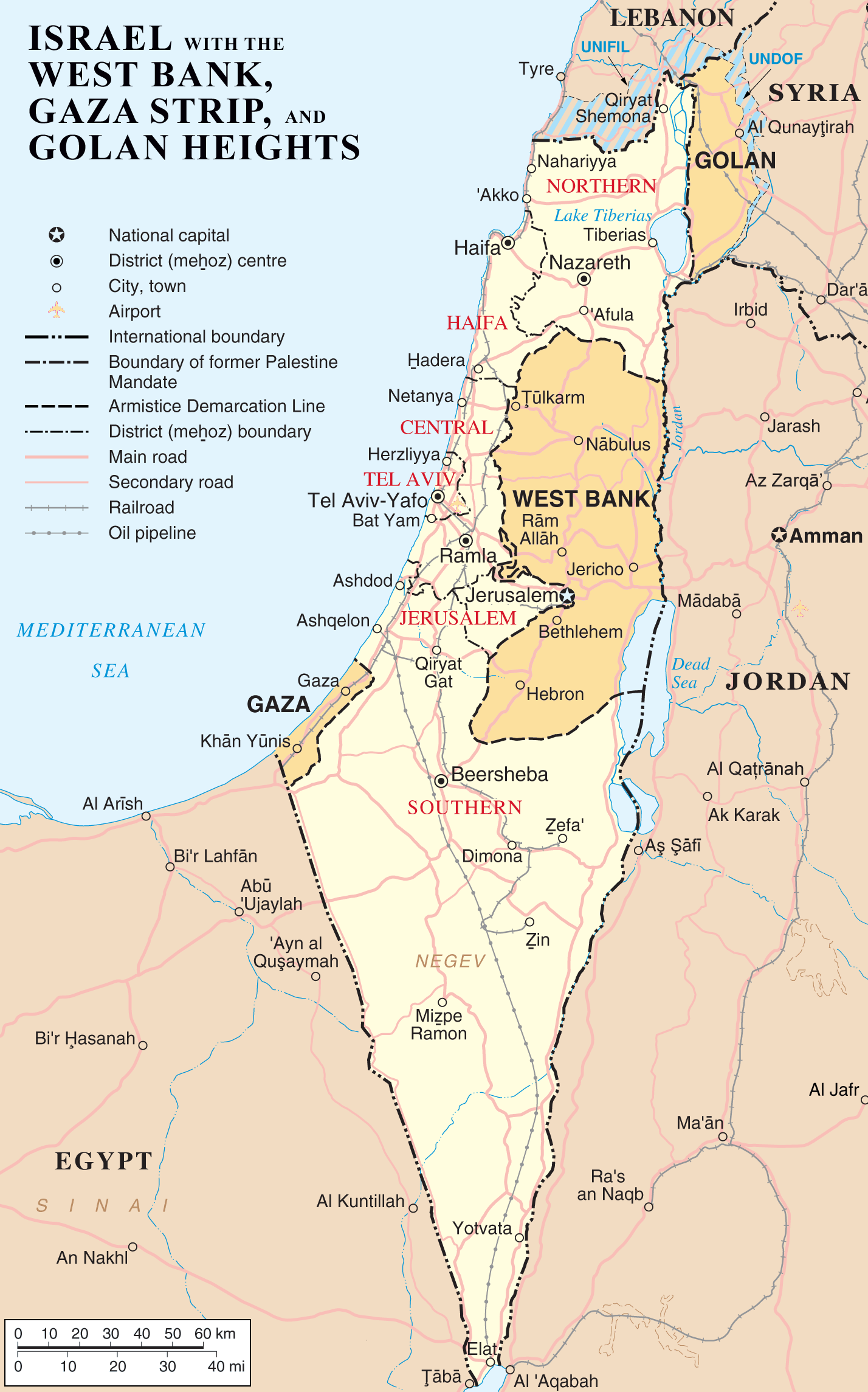
Our itinerary is pretty exciting. We land in Tel Aviv, then spend a few days in Jerusalem (this part of Israel is pretty small, so there isn't much driving involved - here's a good map.). After that, we head off to the North to the Golan Heights, then Tiberias, and then back to Tel Aviv. At some point we head to the Dead Sea for some floating around too. My intention in this series of posts is to capture some of my immediate impressions (whether blogged that day or just written in my notebook, it's too soon to tell).
As you might imagine, there have been plenty of books written on the area. The two I looked into were the Mark Twain travelogue, "The Innocents Abroad"; and Bernard Lewis, "Islam and the West". The latter is more of a collection of essays, but it's pretty interesting reading. I really was looking for some fictional stories that used Jerusalem/Tel Aviv etc. as the landscape/setting, but I haven't tracked anything down (maybe an Agatha Christie book?). I did read the latest Jack Whyte book on the Knights Templar. It is set in First Crusade-era Jerusalem, which was neat, but he doesn't do a great job recreating the landscape; his focus is more on the (frankly boring) history of the Christian religion.
My brother recommended the movie "Route 181", but I haven't had any luck finding it anywhere.
Our itinerary is pretty exciting. We land in Tel Aviv, then spend a few days in Jerusalem (this part of Israel is pretty small, so there isn't much driving involved - here's a good map.). After that, we head off to the North to the Golan Heights, then Tiberias, and then back to Tel Aviv. At some point we head to the Dead Sea for some floating around too. My intention in this series of posts is to capture some of my immediate impressions (whether blogged that day or just written in my notebook, it's too soon to tell).
Subscribe to:
Posts (Atom)